
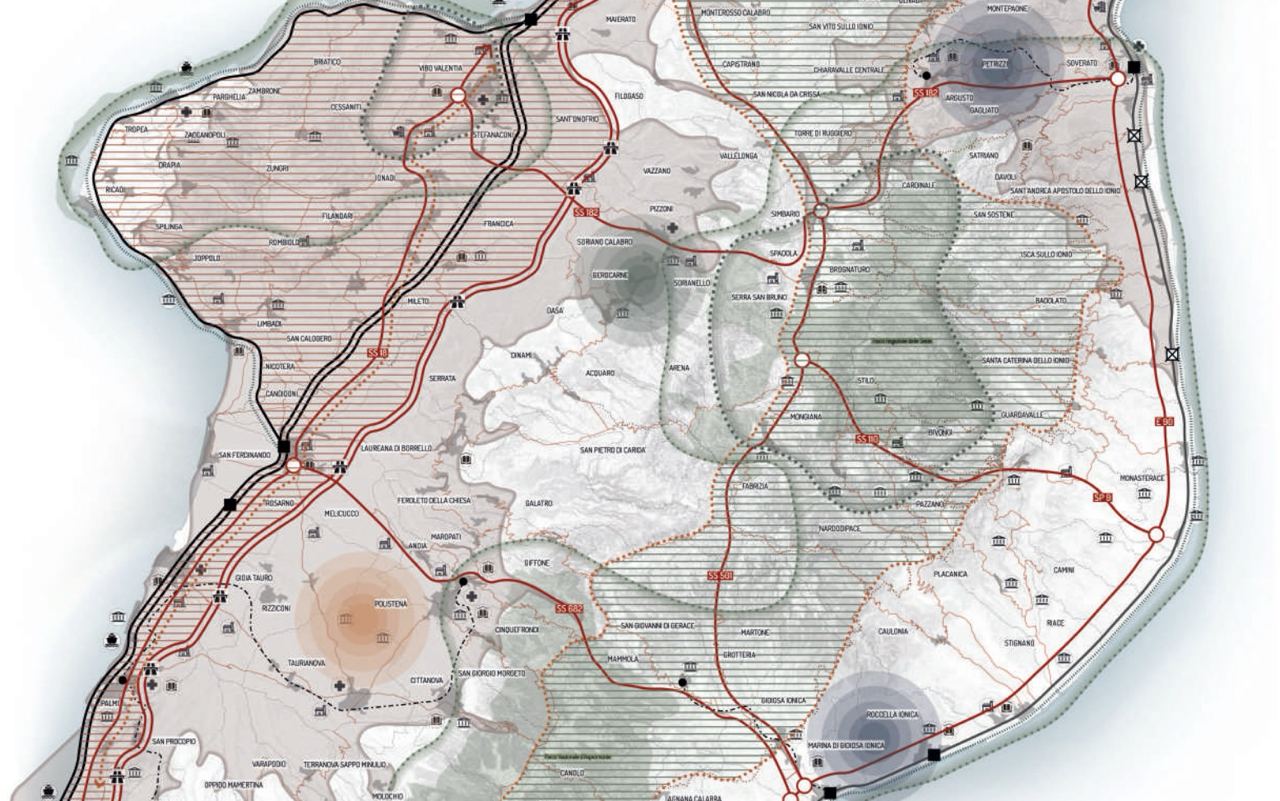
The thesis was developed at the end of the master’s degree by Michela Marzilli and Antonio Pannia to propose a new model of territorial rebalancing. “Eco comunità delle serre calabresi” is a project to relaunch the internal territories of Calabria through the establishment of a Green community whose main objectives are: overcoming the condition of an internal area, strengthening governance, enhancing tourism and energy production from local renewable sources. The research is supported by an economic feasibility study which allows us to materialize the proposals and investigate possible future developments.
The Project intends to delve into the dynamics that have led to the marginalization and depopulation of most Calabrian municipalities, to find strategies to reactivate small towns, directing interventions on accessibility and social and economic development. The starting point is a particularly diversified territory, both from the point of view of settlement but also of services and mobility, spanning three provinces, Vibo Valentia, Catanzaro and Reggio Calabria. A part of this territory appears to be lacking in services and mobility infrastructures, with a continuously increasing trend of depopulation and with a strong marginalization compared to the larger urban centres, providers of essential services, but at the same time rich in ecosystem services and heritage archaeological historians. Hence the project proposal is to create a Green Community made up of ten municipalities that have similar settlement, environmental, morphological, social and cultural characteristics. To intervene on governance and manage the territory in the form of a community of municipalities, working on three themes, the condition of the Internal Area, the valorisation of environmental tourism and the production of energy from renewable sources. The working method used was characterized by three phases, one of analysis of the territory and the socio-economic-demographic dynamics relating to the entire region through collaboration with local administrations. The second phase was the analysis of the data that emerged, identifying the critical issues and resources. As a third phase, some sectoral objectives and strategies were identified, to then define a series of interventions to be implemented in the area with the bodies involved. The project theme carried out is extremely current, thanks to the PNRR (European funds) the theme of Green Communities has become a priority, financing 35 new communities. Given the complexity of the project, we expected a few years for its complete implementation. An important evolution is to make administrators aware of the potential that exists, working in synergy with neighboring municipalities, to achieve common objectives. The future development and repopulation of these areas starts from a territorial regeneration that considers different realities and knows how to join forces.
link to download the thesis: https://we.tl/t-9vgTeCLV5T