Optimizing the efficiency of photovoltaic (PV) systems by determining the most economically and environmentally favorable tilt angles for solar panels. Conventional fixed tilt angles can result in efficiency losses, impacting the overall energy-harnessing capabilities of solar panels. While solar trackers can enhance efficiency, their economic feasibility is a concern. This research aims to bridge this gap by developing a mathematical model, integrated into buildings, that considers various factors such as shading, albedo, and environmental variables. The goal is to determine optimal monthly and seasonal tilt angles, crucial for economic evaluations, by utilizing data from the Energy Performance Calculator and EnergyPlus Weather data. The significance of this study is to provide a precise, open-source tool for consultants, enabling site-specific recommendations and aiding in the selection of the most suitable solar systems for diverse locations.
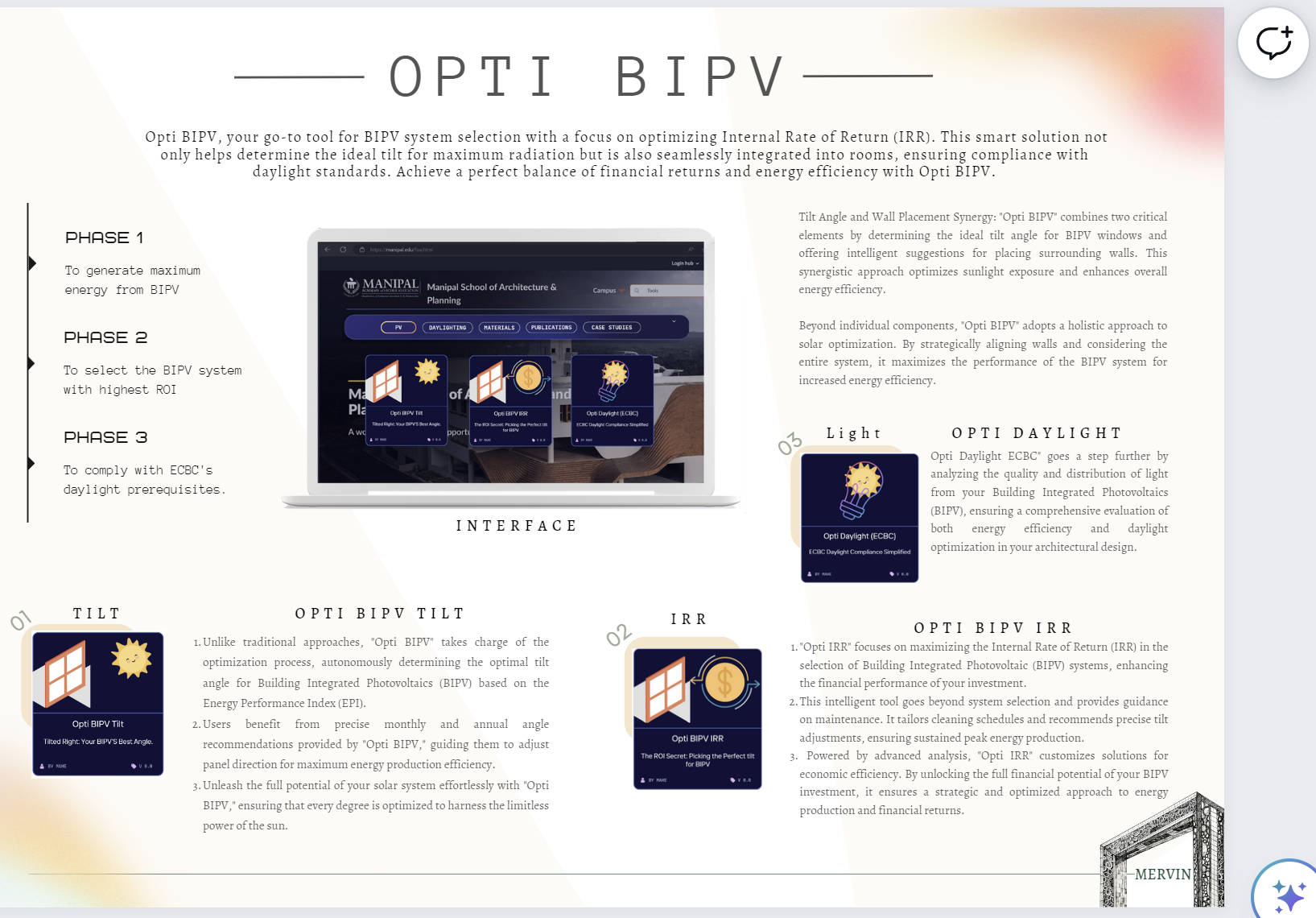
PV Tools: Opti Tilt, Opti IRR
“Opti Tilt” is the next evolution in solar panel optimization. In contrast to PV Watts, which relies on default angle settings, “Opti Tilt” empowers users to automatically determine the ideal tilt angle for their solar panels keeping EPI as objective. This innovative tool provides precise monthly and annual angle recommendations, ensuring maximum energy production. Unleash the full potential of your solar system with precision and efficiency—because every degree counts when it comes to harnessing the power of the sun.
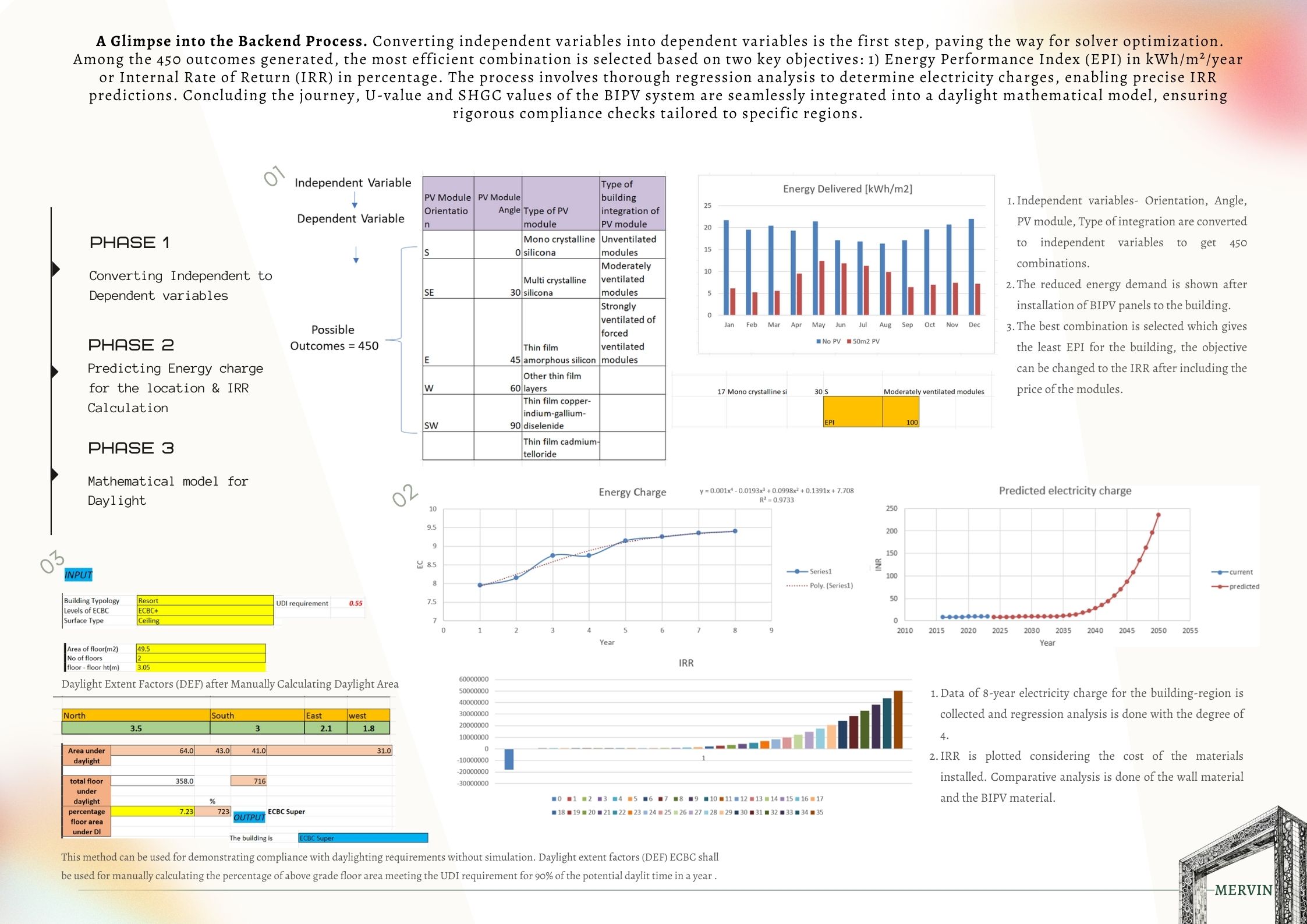
“Opti IRR” transforms PV system selection, prioritizing the highest Internal Rate of Return (IRR). It’s more than just choosing a system—it offers guidance on maintenance, from cleaning schedules to tilt adjustments for peak energy production. Powered by advanced regression analysis, “Opti IRR” considers energy rates and regional development, providing a customized, efficient, and economically sound solution for your solar investment. Get ready to unlock the full potential of your PV system’s financial returns.
Abstract
PV system efficiency peaks when solar panels are aligned perpendicularly to incident radiation. Therefore, while solar trackers are the most efficient, their economic feasibility is questionable due to higher upfront and operational costs. Solar panels require maintenance due to dust/soiling impacting efficiency,and adjusting tilt angles six times annually captures 99.5 percent of solar radiation. Hence, this study aims to identify optimal monthly and seasonal angles for further economic evaluation. Addressing the need for a computationally efficient tool, this research develops a mathematical model that utilizes the Energy Performance Calculator (EPC). It determines the optimal tilt angle for solar panels using data extracted from the EnergyPlus Weather (EPW) data file to find the optimal placement of solar panels, allowing for further modifications, but not limited to, shading, albedo, BIPV, environment, and architectural variables. The analysis contrasts the EPC model with other solar geometry models, presenting a 3rd-order polynomial fit that correlates the ideal tilt to latitude for Rooftop PV and BIPV. The study underscores the importance of calculating precise tilt angles for accurate results in their respective locations.